Bob Moses, a Student Nonviolent Coordinating Committee (SNCC) pivotal leader, described fellow SNCC captain Charles McDew as "Black by birth, a Jew by choice, and a revolutionary by necessity." McDew served as the second chairman of the Student Nonviolent Coordinating Committee (SNCC) from 1961 to 1963, following Marion Barry and preceding John Lewis.
Yet, when historian Marc Dollinger wrote “Shared Struggles, Shared Stories: Black Power, Jewish Politics, and the Fight for Justice,” it did not include McDew. Ilana Kaufman, who read the book just before publication and wrote the Afterward, repeated during the session her first impression, “There was not a single Black Jew among the 250 pages of the book.” As a result of the conversation, Dollinger added appendices.
He has since learned to use the words “American Jew,” and “White Jew” to be precise and more inclusive.
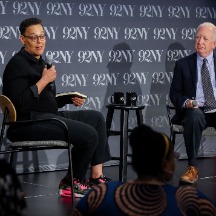
Kaufman shared her critical remark during a 92NY live and streamed session last week. The session featured Dollinger and Kaufman in conversation with Jewish scholar Susannah Heschel. During the scholarly session, Dollinger admitted, “I wrote a whole book about Black Jews and never knew McDew existed.” He blamed his oversight on there not being any archived materials on Black Jews.
Even when crediting the African Affirmation movement of the 1960s for inspiring Jews to follow suit, he introspectively concluded that he could not “unwhite history.” However, he has since learned to use the words “American Jew,” and “White Jew” to be precise and more inclusive. By specifically saying “White Jew,” it keeps the word Jew from meaning “White Jew,” by divine default.
Kaufman, founder of The Jews of Color Initiative, says if she wrote a similar book, she would explore the deep investment many Jews have made into “Whiteness.” She thinks some Jews hide their Jewish identity and acculturate out of “fear.” She affirmed, “Black (Jewish) people don’t have that option.”


Complexity: Black Power, Jewish Politics, and the Fight for Justice
Features
Blacks never got the invitation to Whiteness that White Jews got and accepted, she explained. However, she warned, when the White Nationalists come to get us, “we are all being hunted.” Instead of looking for our differences, she admonished, we should focus on our “collective survival.”
Jews of Color Initiative focuses on domestic life and realizes that many assume all Jews of Color are anti-Zionist. She said, one of my biggest policy decisions for the group was “to not talk about Israel,” but to focus on a less conflict-ridden issues including creating a safe space for Jews of Color.
Heschel chimed in on the lack of inclusiveness, too. She noted that conclaves of “Christians, Jews, and Muslims,” often only feature White males.
Kaufman pivoted from the Black-Jewish world to the general Jewish world by noting that the need to cling to Whiteness even affects how they build synagogues as churches. “In a very traditional Orthodox synagogue, there would be a barrier between men and women.”
I am not sure what one would like in the United States, she pondered, for instance, in the United States, “the images in the synagogues will reflect various races.” “There is a cost,” she says of acculturating.
Jews of Color Initiative focuses on domestic life and realizes that many assume all Jews of Color are anti-Zionist. She said, one of my biggest policy decisions for the group was “to not talk about Israel,” but to focus on a less conflict-ridden issues including creating a safe space for Jews of Color.
Heschel chimed in on the lack of inclusiveness, too. She noted that conclaves of “Christians, Jews, and Muslims,” often only feature White males.
Kaufman pivoted from the Black-Jewish world to the general Jewish world by noting that the need to cling to Whiteness even affects how they build synagogues as churches. “In a very traditional Orthodox synagogue, there would be a barrier between men and women.”
I am not sure what one would like in the United States, she pondered, for instance, in the United States, “the images in the synagogues will reflect various races.” “There is a cost,” she says of acculturating.
Support for Port of Harlem magazine
Like many publications, including the famed AP, our advertising revenue is not keeping pace with expenses. If you have not donated to our non-profit or have not become a POH Podcast supporter, we ask you for a donation. If you want to see more stories such as this one, please donate now. No amount is too little.

follow us on


Advertisers | Contact Us | Events | Links | Media Kit | Our Company | Payments Pier
Press Room | Print Cover Stories Archives | Electronic Issues and Talk Radio Archives | Writer's Guidelines