Linwood continued, “That’s right. We also call it Spanish Harlem because in 1917 the United States passed a law granting Puerto Ricans citizenship. Many Puerto Ricans then traveled to Manhattan, settling right here.”
He shifted his weight and pointed slightly toward downtown.
“Some settled in the Lower East Side, but many came up here, to the East Side of Harlem.”
Connie raised an eyebrow. “Why here, though?”
Affordable housing,” Linwood said. “Those old tenements were cramped, but they fit the budget of newly arrived immigrants. With factory jobs nearby, it seemed like a fair shot at stability. Not perfect but possible. Connie, you remember those tenement buildings we grew up in. They weren’t luxury.”
Connie smiled. “Yeah, rent was about seventy-five dollars a month for a two-bedroom back in the early seventies. My mom complained more about the tiny critters than the rent.”
Linwood glanced down the tracks just as a low vibration rippled through the platform under their feet. A moment later, the train appeared, a silver bullet racing toward them. The roar of metal filled the air, drowning out everything else.
The group stepped back as a gust of wind rushed past, whipping Renee’s scarf across her face. For a few intense seconds, they were inside the sound, feeling the train’s power in their bones.
Then it was gone, leaving a sudden, ringing silence. Linwood’s expression changed, more reflective now.
“That sound,” he said, “takes me right back. When I was eight or nine, I used to spend summers at my Aunt Cynthia’s place on 112th St. and Park Ave. Early mornings, before anyone was up, I’d sneak into the front room and watch the trains roll by.”
He paused. “From inside, it wasn’t loud like this. More like a soft tremor, a hiss on the rails. Then it would glide past, quiet and smooth. Every time I stand here, I think of that window, the steady thump-thump of the wheels, the smell of coffee in her kitchen, my cousins still asleep on the floor. Good times.”
Shirley gave him a playful look. “That’s sweet. But my cousins were loud enough to scare trains off the tracks.”
Linwood smiled, a trace of nostalgia in his eyes. “Yeah, when my cousins woke up, the living room turned into Showtime at the Apollo. Pots for drums, brooms for microphones. The whole house was a talent show.”
The group laughed, and Linwood paused, losing his thought for a second before finding it again. “We still call this Spanish Harlem, but most folks on the East Side today aren’t Hispanic. It’s a mix of Black, Brown, White, and everything in between.
He then asked, “Before it was called Spanish Harlem, does anybody know what it was called?”
James, thoughtful, offered a guess. “Was it… Little Spain?”
“Good guess, but no. That’s a different part of Manhattan altogether.”


The Last To Come, First To Stay
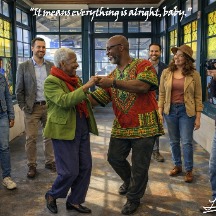
He then delivered the surprise. “It was called Little Italy.”
A few eyes widened in surprise.
A few eyes widened in surprise.
“That’s right,” Linwood said. “Little Italy. And it predated the one you’ve probably heard about downtown by nearly two decades. Up here, they called it Italian Harlem, and it was full of Italian families, bakeries, social clubs, and Catholic processions, the whole deal. Patsy’s and Rao’s are famous Italian restaurants still here since 1886 and 1933 respectively.”
Frieda raised a brow. “So what was it before it was Italian Harlem? French Harlem?”
Linwood smiled. “Not quite.” He paused, letting the question do a little work.
“It was Jewish. And before that, German. Before that, Irish.”
A few heads tilted as the pattern started to form.
“Each group came here for the same reasons,” Linwood said. “Cheap rent. Work. A chance to get a foot in the door.”
Connie blinked. “Damn. That’s a revolving door of passports.”
LaTanya said quietly, “It sounds like a ghetto to me.”
Linwood looked at her, impressed. “You’re right. Originally it was an European ghetto. Packed with immigrants scraping by, sometimes ten to a room. Same poverty, different faces.”
Frieda blinked. “I never thought about it like that.”
Even Shirley let out a low whistle. “Well, damn. That flips the narrative. They always acted like the neighborhood only went downhill once we showed up. Turns out, the struggle was here long before we were.”
The group went quiet for a moment. The truth needed a second to settle.
“Now here’s the million-dollar question,” Linwood said. “What group was the last to come here and stay in the early 1900s?”
They looked at each other, uncertain.
Then LaTanya quietly removed her earbud and said, “Black people.”
Linwood’s face brightened. “That’s right. The last major group to arrive and stay in the early twentieth century, during the Great Migration, were the descendants of the enslaved and free Black people looking for a new start. Thanks to real estate pioneers like Philip A. Payton Jr. and the expansion of new subway lines, Harlem became a place where Black families could finally build a decent life and stay.”
A train whistle sounded in the distance, steady and rhythmic, almost like a hip-hop beat. Right on cue Linwood said, “We came, we saw, we conquered. Harlem style.”


follow us on


Advertisers | Contact Us | Events | Links | Media Kit | Our Company | Payments Pier
Press Room | Print Cover Stories Archives | Electronic Issues and Talk Radio Archives | Writer's Guidelines